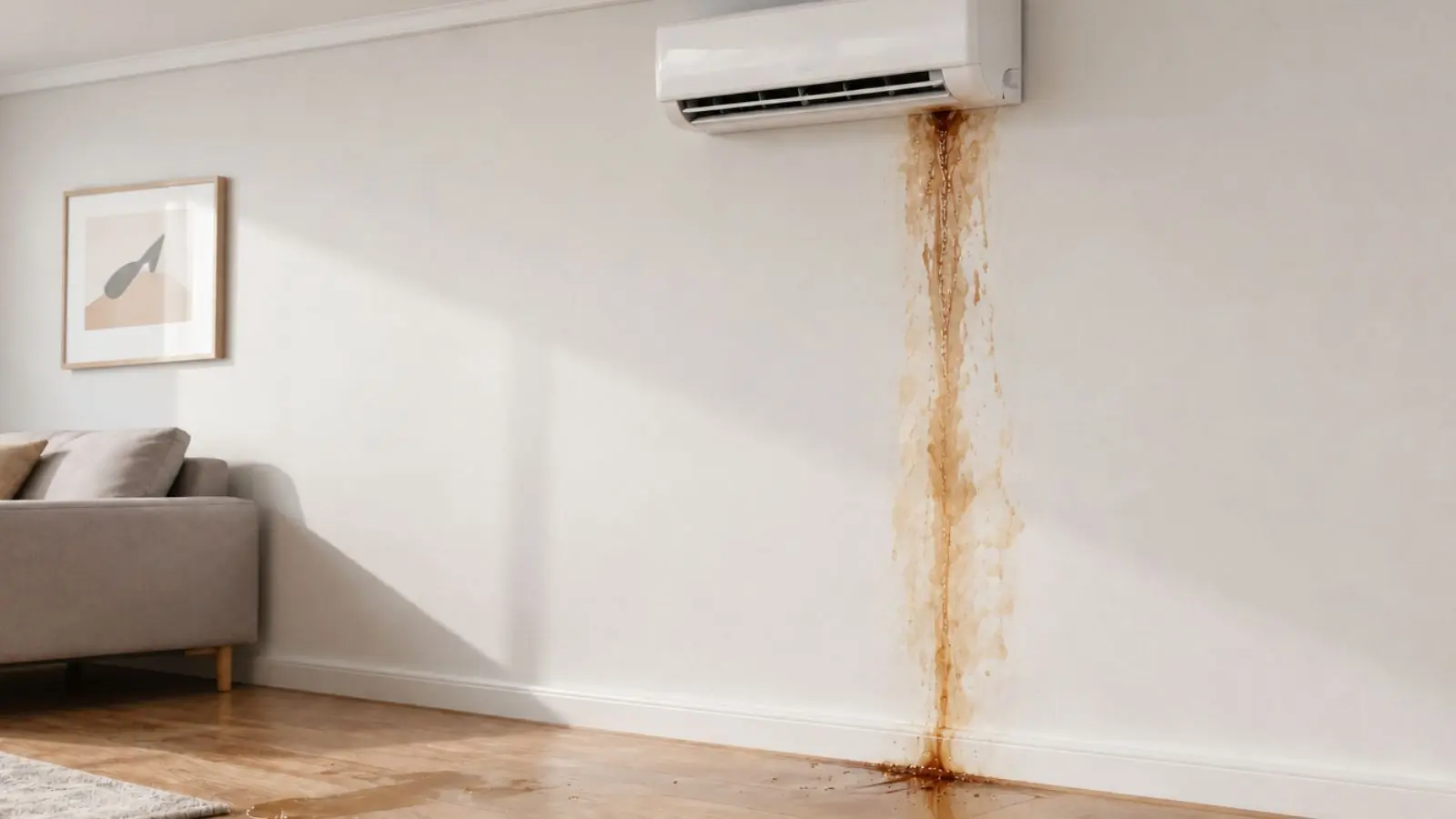
Where AC Water Comes From and Why It Escapes
AC leak water damage is the wet insulation, stained ceilings and soft flooring left behind when an air conditioner's condensate water escapes its drain system. Cooling air pulls moisture out of the air, and that water has to leave through a drain line. When the line clogs or the pan overflows, it goes into the building.
NOAA's 1991 to 2020 normals for the nearest long-term station, Reagan National Airport, put the July mean temperature at 81.0 F. A Mid-Atlantic summer like that keeps cooling systems running for months, so the air handler makes a lot of condensate. A line that is nearly blocked in June may overflow by August.
Because the water drips slowly, the first sign is often a small brown ring on a ceiling. Behind it, insulation may be soaked and framing damp.
Signs From a Ceiling Stain to a Wet Closet
The first sign depends on where the air handler sits.
| What you see | What is probably wet | First move |
|---|---|---|
| Brown ring or bubble on a ceiling | Insulation and drywall below an attic air handler | Turn the AC off, place a bucket, call HVAC and the line |
| Musty closet or wet floor beside the air handler | Drain pan overflow into a closet or utility room | Turn the AC off, check the drain line outlet, dry the floor |
| Water dripping from a vent or register | Condensation or a flooded duct run | Turn the unit off and call HVAC |
| Sagging ceiling with water bulging | A pooled water load held by drywall | Stay clear of the area, turn the AC off and call the line |
| Damp baseboards below a wall unit | Slow drip tracking down the wall | Dry the surface, locate the source, call for moisture mapping |

AC Leak Safety in the First Hour
Turn it off, then think about the ceiling
Water and wiring share the attic and the air handler closet. Treat any soaked ceiling light or fixture as a hazard.
- Turn the AC off at the thermostat. Cooling keeps making condensate, and a stopped unit stops the supply of new water.
- If water is coming through a light fixture or touching outlets, stay out and call 911 and your electric utility. Cut power only if the panel is dry and safe to reach.
- Do not walk on a sagging ceiling or stand under a bulge. Wet drywall and insulation are heavy and can fall.
- Call an HVAC company for the unit, and call the line for the water damage. The two jobs are separate.
Condensate Lines, Pans and Float Switches
Most AC leaks come from a short list of parts in the drain path.
Clogged condensate drain line
Algae and debris build up in the line and slow the flow. The water backs up into the pan and then over the edge.
Overflowing drain pan
The pan under the coil catches condensate. A cracked or rusted pan, or one with a blocked outlet, spills onto the surface below.
Failed float switch
Some units have a switch that shuts the system off when the pan fills. If it fails, the unit keeps running while it leaks.
Sweating ducts
The EPA says condensation can form on uninsulated cooling ducts, since warm humid air hitting a cold surface leaves water behind.
Ceiling dripping from the AC?
Turn the unit off, then call the line about the wet ceiling.
What a Drying Visit Involves
- 1
Locate the wet zone
A moisture meter and a thermal imaging camera show how far water spread across the ceiling, wall cavity and attic floor.
- 2
Remove what will not dry
Soaked insulation and soft drywall are cut out. Dry sections are kept where possible.
- 3
Dry the structure
Air movers and LGR dehumidifiers run until the framing returns to dry reference points. The ANSI/IICRC S500 standard is the published guide, so ask any company if its crews follow it.
- 4
Check for mold and plan repairs
If mold is present, mold remediation follows ANSI/IICRC S520 containment, HEPA air scrubbers and negative air. Once dry, finishes can be repaired.
Humidity, Mold and the Rest of the House
The EPA's mold guidance says indoor relative humidity should stay below 60 percent, and ideally between 30 and 50 percent. A system that is not draining may leave the home both wet and humid. Mold needs moisture, so the water source has to be fixed before any cleaning makes sense.
The EPA also says to keep air conditioning drip pans clean and the drain lines unobstructed, and to dry water-damaged areas within 24 to 48 hours. A slow drip that soaks attic insulation for a summer can pass that window many times over, so a wet attic should be checked, not assumed dry. Health questions about mold belong with a physician.
What Changes the Size of an AC Leak Job
Pan overflow caught within a day
Scope: one closetWater on a closet floor, dried in place.
Ceiling stain from a slow drip
Scope: one ceilingSection of drywall and insulation removed, framing dried.
Leak ran through a summer
Scope: attic and rooms belowWide insulation loss, damp framing and ceilings in more than one room.
Long leak with mold present
Scope: containmentMold work is added and follows its own standard, S520.
Duration, access to the attic or closet, materials and drying days set the price, with no dollar figure given before the scope is understood.
Insurance, Slow Drips and Timing
The Maryland Insurance Administration says most homeowners policies will not cover damage that results from a slow leak. A condensate line that dripped all summer looks like that, while a pan that cracks and overflows in one night may be treated differently. The cost of the HVAC repair itself is usually a separate question. Check your policy or ask your insurer.
The MIA also says mold is excluded in most policies unless it results from a covered peril. Take dated photos and report soon, because Maryland's COMAR 31.15.07.03 sets claim handling timelines for insurers starting at 15 working days to acknowledge a claim, with exceptions.
Mistakes and Prevention
- Do not keep running the AC after you see a ceiling stain. The unit keeps making water.
- Do not paint over a stain. Paint hides moisture and does not remove it.
- Ask an HVAC company to clear and test the condensate line before the cooling season starts.
- Check the drain pan and the outlet of the drain line a few times each summer if the air handler is accessible.
- Do not ignore a musty smell in a closet or attic stairwell.
Related Pages and Nearby Towns
After the ceiling is dry, water damage repair covers how finishes are rebuilt. For the drying phase itself, water mitigation explains the equipment and monitoring in more depth. Other indoor sources are covered on the appliance leak page.
Crews serve Bladensburg and College Park as well, where summer heat puts the same load on cooling systems.
Frequently asked questions
The (301) 936-0619 line is staffed 24/7. Crews respond the same day when available, and no arrival time is promised on the call. Turn the AC off at the thermostat while you wait.
No. An HVAC company repairs the unit and clears the condensate line. This service handles the wet ceilings, insulation, framing and floors.
Cooling makes condensate, and the drain line has to carry it away. A clogged line overflows when the system works hardest, which is usually the hottest months.
A fan helps surface drying but does not reach wet insulation or framing above a ceiling. A moisture meter shows what is still wet.
Condensate is usually treated as relatively clean, but standing water in a pan or line can carry algae and debris. Crews assess the water category on site.