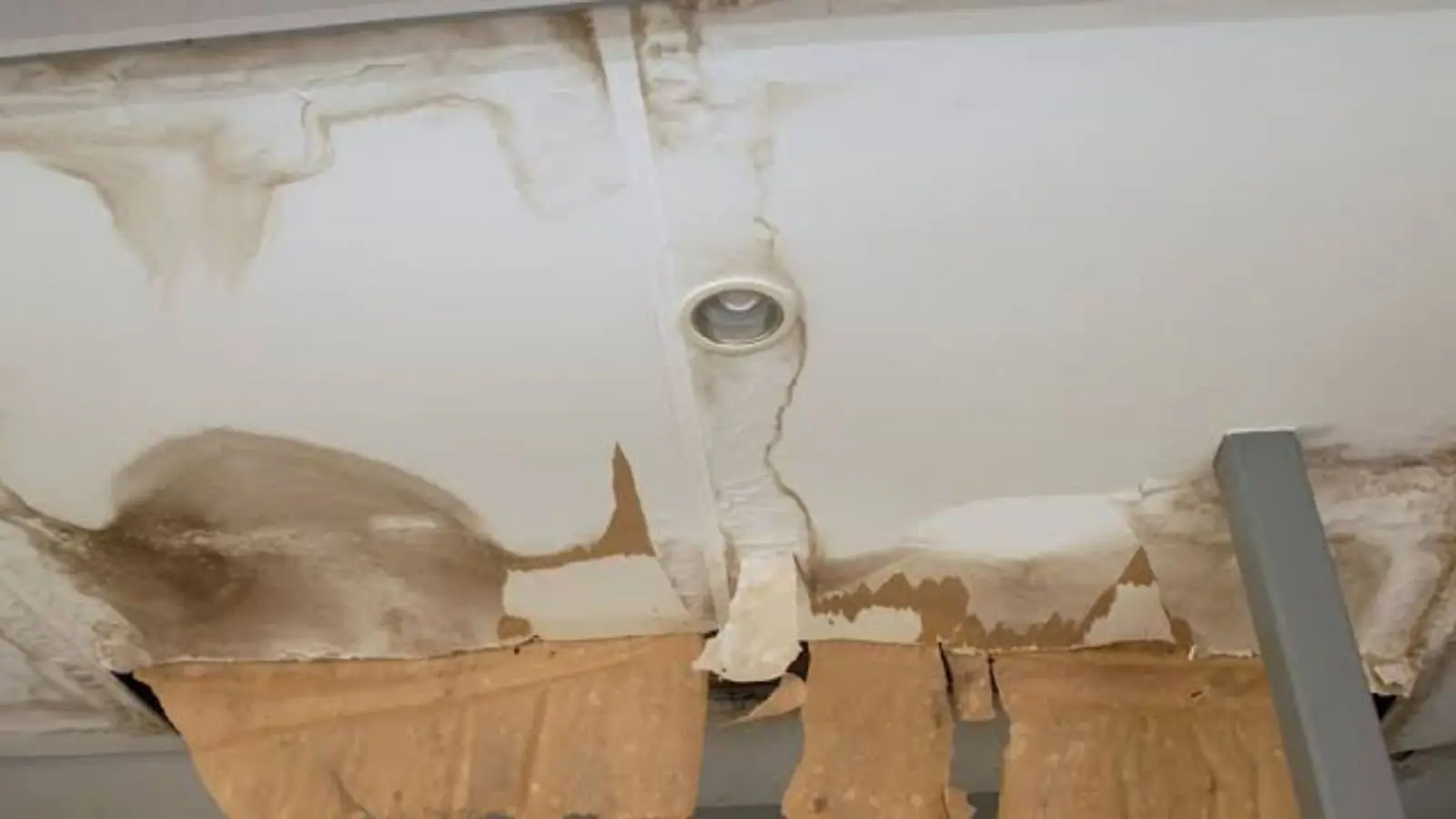
The short version: stop, relieve, dry, replace, seal
To fix a water-damaged ceiling, stop the source of the water, safely release any trapped water, dry the area until a moisture meter reads normal, cut out and replace the damaged drywall, then prime the stained area and paint. Skipping the drying step is the most common reason a patch stains again.
A small brown ring on sound drywall can sometimes just be primed and painted once it is dry. A sagging, bubbled or crumbling section is different, because wet gypsum board loses its strength and should come out.
Relieve a bulging ceiling, and know when to stay out
Water trapped above a ceiling can drop suddenly
A bubble or belly in the ceiling is usually water pooled behind the paint and drywall. Left alone, it can collapse and bring insulation and debris with it.
If the room has no live wiring or fixtures in the wet area, you can relieve it. Move people and belongings out, place a bucket under the lowest point, and wear eye protection. Poke a small hole at the center of the bulge with a screwdriver, stand to the side, and let the water drain.
Treat a ceiling as unsafe if it is sagging across a wide area, has visible cracks, or drips near wiring or light fixtures. Wet drywall is heavy, and a collapse can injure someone. Stay out from under it and keep children and pets away.
If you smell gas, leave the building and call 911 and the gas company from outside. Washington Gas lists 844-927-4427 as its leak line. Never use a switch or flame near a wet ceiling you suspect is carrying wiring.
- If the bulge sits near a light fixture, outlet or fan, do not poke it. Cut power only if the panel is dry and safe to reach.
- If the bulge is wide or the ceiling is cracked, stay out of the room.
- Water from a toilet, sewer or flooded drain is contaminated, so do not handle it. Call the line.
Fixing the ceiling in five stages
- 1
Stop the source
Repair the roof leak, close the supply line, replace the failed seal or clear the condensate line. Nothing else lasts until this is done.
- 2
Dry the structure
Open the area, remove wet insulation, and run air movers and a dehumidifier. Check with a moisture meter, since a surface that feels dry can hold water behind it.
- 3
Cut out the damaged drywall
Mark a square or rectangle past the stained and soft area, cut to the nearest joists, and remove it. Keep the cut clean so the patch fits.
- 4
Install new board and finish the seams
Fasten new drywall to the framing, tape the seams, apply joint compound in thin coats, and sand smooth between coats.
- 5
Prime the area and paint
Use a stain-blocking primer on the repaired area and any remaining stain, then paint the whole ceiling plane so the sheen matches.
Ceiling sagging or dripping?
Call (301) 936-0619 and describe the bulge, the source and whether water is still coming.
Why drying takes longer than it looks
Drywall drinks water through its paper face and holds it in the gypsum core. The surface can feel dry to the touch while the board and the framing above it are still damp. A moisture meter reading compared with a dry section of the same ceiling tells the truth.
If the cavity above is closed, drying often needs a small opening so air movers and LGR dehumidifiers can move air through it. Thermal imaging helps locate wet insulation without tearing out more than necessary. Crews that follow ANSI/IICRC S500 document readings each visit, and you can ask any company whether it does.
Repair or replace: a quick decision frame
| Condition | Usually | Reason |
|---|---|---|
| Faint ring, hard surface, meter reads dry | Prime and repaint | The board kept its strength and the water is gone |
| Bubbled paint, board still firm | Dry, test, then scrape and prime | Paint failed but the gypsum may be sound |
| Soft, sagging or crumbling drywall | Cut out and replace | Wet gypsum board loses strength and holds moisture |
| Wet insulation above the board | Remove and replace insulation and board | Insulation stays damp and keeps the framing wet |
| Ceiling soaked by contaminated water | Remove affected material | Category 2 or 3 water calls for removal, not cleaning |
| Stain keeps returning after repair | Find the source again before repainting | Moisture is still entering |
Hyattsville, MD: rain, roofs and permits
The city's own stormwater study calibrated its model using two storms: 2.96 inches over about 5.5 hours in August 2014, and 4.21 inches over about 15 hours in July 2017. Rain at that pace puts real load on roofs, gutters and flashing.
For repair work, the city's resident brochure says most construction work requires a permit from Prince George's DPIE. Permit rules vary by the work, so ask DPIE or the city before rebuilding walls, electrical or plumbing, including ceiling work that touches wiring.
Getting stains to stay hidden
Ordinary paint will not hold back old water marks, and stains can bleed through several coats. A stain-blocking primer applied after the area is dry gives the topcoat something stable to cover. Spot-painting often leaves a visible patch, so most people repaint the full ceiling.
For larger jobs, professional water damage repair handles the tear-out, replacement and finishing as one sequence after drying. Water damage cleanup comes first if the room still has standing water or wet contents.
The line also serves Riverdale Park, covered on the Riverdale Park water damage restoration page, and Bladensburg, covered on the Bladensburg restoration page.
Frequently asked questions
Only after the source is fixed and the drywall reads dry. Use a stain-blocking primer first, since regular paint tends to let the brown ring show through.
It can be, if the bulge is away from wiring and light fixtures and the water is clean. Stand to the side, catch the water and wear eye protection. If wiring is near or the water is contaminated, call the line instead.
No. A faint stain on firm drywall that has dried can often be primed and painted. Soft, sagging or crumbling board should be replaced.
The EPA advises drying water-damaged areas within 24 to 48 hours to prevent mold growth. Drying should continue until a moisture meter reads normal for that material.
Permit rules vary by the work. The city's brochure says most construction work requires a permit from Prince George's DPIE, so ask DPIE or the city before rebuilding walls, electrical or plumbing.
Sudden and accidental water damage is often covered, and gradual leaks often are not. Check your policy and ask your insurer, and document the ceiling with photos before repairs.